
Challenging your thoughts – from black-and-white to shades of grey
A key feature of perfectionism is the belief that there is only one result that is good enough. Anything that does not reach this standard is therefore seen as inadequate or a failure. In other words, there is no “middle ground” – only extremes: success or failure.

As a result, people with perfectionist tendencies often spend a lot of time and energy on behaviours aimed at maintaining these high standards.
These thought patterns are often characterised by a certain rigidity – a feeling that things must be a particular way. The problem is that even if we do manage to reach the standard we have set, there is a risk that we dismiss the achievement or raise the standards even further next time. In this way, our view of what is “good” or “bad” becomes increasingly rigid.
If, on the other hand, we do not succeed in meeting our standards, this often leads to self-criticism and a strong belief that we need to try even harder.
To break this pattern, we need to become more flexible in how we interpret what happens and increase our awareness of how we think.
Developing more nuanced thinking
The type of thinking in which something can only be one of two things – “all or nothing” – is known in psychology as dichotomous thinking. This means that two things are set in direct opposition, and the thought process is shaped by extremes.
This kind of thinking is understandable and can sometimes be helpful. It saves mental energy and allows us to make quick decisions. However, the downside is that we may miss important information. This can lead us to interpret situations in ways that are neither helpful nor fair.
In perfectionism, this becomes particularly clear, as it often leads us to only interpret outcomes only as either good or bad.
Exercise – creating a continuum
To become more flexible in our thinking, we need to move away from this division into two extremes. One way to begin doing this is by using a continuum – a scale where we place different qualities or performances. In this way, we can see more nuances than just the end points.
Follow the instructions below to create your own continuum.
- Describe your “all-or-nothing” thinking
Identify an example of an all-or-nothing thinking that you often engage in. You can use something you have previously written down or reflect on how you usually think.
Example: ”I must know everything, otherwise I’m completely worthless.”
- What characterises this way of thinking?
Reflect on what characterises this division and what is at the core of the idea.
Example: “Know nothing or know everything.”
- Are there more elements to this?
Take a moment to consider whether there are additional aspects to this. For example, “knowing everything” or “knowing nothing” can often consist of several different parts.
Example: If you are studying to become a history teacher, knowledge is not limited to one area. It may include the Middle Ages, World War II or modern history.
- Create a continuum
Draw a line between the extremes and place a mark where you fall different parts of the area, as in the example below.
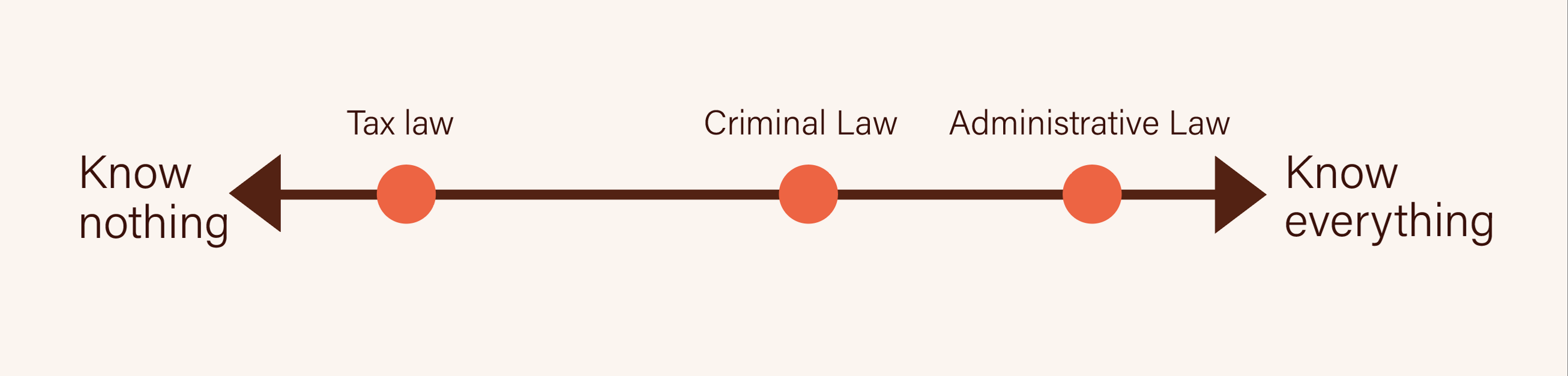
5. What have I learned?
Reflect on what you can take away from the exercise. Often, something that at first felt very divided – such as “know nothing” or “know everything” – turns out to consist of several different dimensions.
The aim is not to try to score highly on every part, but to get a more nuanced perspective on your performance.
In the next section, we will look more closely at perfectionistic tendencies to dismiss positive experiences and attribute success to chance.