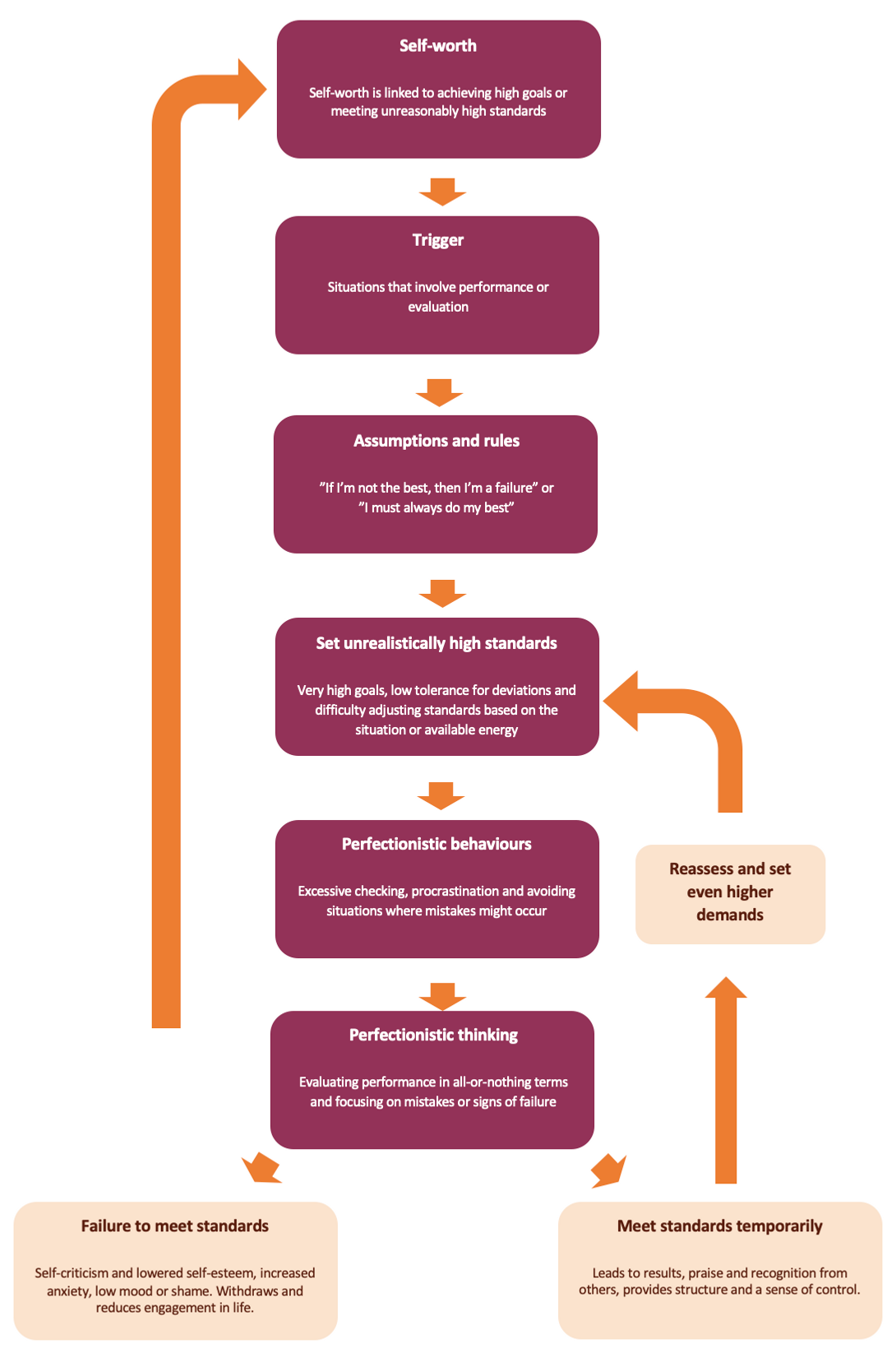
A model of perfectionism
The foundation of perfectionism is laid when, over a long period of time, a person places great importance on striving for and achieving high standards. Over time, this striving can become crucial to how the person experiences their self-worth.

When the person finds themselves in situations involving performance or evaluation, what psychology refers to as assumptions and rules are activated, which the person feels they must live up to.
In order to live up to these rules, the person often sets unrealistically high standards for themselves and becomes stuck in perfectionistic behaviours, such as excessive checking, procrastination and avoiding situations where mistakes might occur.
This is often accompanied by perfectionistic patterns of thought, such as all-or-nothing thinking. The person also develops a distorted way of evaluating themselves, focusing mainly on mistakes and failures, while overlooking what has gone well.
If the person fails to meet their standards, this is often followed by strong self-criticism, which reinforces the belief that their value depends on performance. However, if the person manages to meet their standards, the sense of relief is often short-lived. The standards are reassessed and raised before the next situation.
Lisa's example
Lisa comes from a fairly difficult background and has not always received the attention, encouragement or validation she needed from her parents. As a result, she often feels insecure and less valuable than other people. At the same time, she has always found school easy and achieved high grades, which has led to attention and praise from those around her. This has laid the foundation for her perfectionistic tendencies.
Thanks to her academic ability, Lisa has now been accepted onto the law programme, a demanding and prestigious course of study. She now finds herself in a new and challenging environment, with many situations where she must both perform and be evaluated. The external demands have thus increased, which means that her perfectionist traits – which were not previously problematic – are now beginning to create difficulties.
When Lisa is faced with situations involving performance or evaluation, she sets very high standards for herself and makes assumptions about what will happen if she does not live up to them. She often thinks: “I must always do my best…” and “if I don’t do my best, then I’m not good enough and I’m worthless.” These thoughts lead her to set unrealistically high standards for herself.
To live up to these rules and assumptions, Lisa repeatedly goes over, checks and overworks what she has done down to the smallest detail. As a result, she neglects large parts of her life in order to minimise the risk of making mistakes or failing. At the same time, this behaviour leaves her feeling increasingly tired and exhausted.
In her perfectionism, Lisa also has a pattern of thinking in which she evaluates herself and what she does in all-or-nothing terms – either it is good or bad, with no room for anything in between. When things go well, she thinks that it is because of luck or chance, and when things go badly, she thinks it is entirely her own fault.
When Lisa fails to live up to her standards at university, this often leads to strong self-criticism and lowered self-esteem. It can also lead her, at times, to withdraw from other people and stay at home. When she succeeds, however, the sense of happiness rarely lasts very long. Instead, she quickly reassesses the achievement and thinks, “it was probably too easy”. This leads her to raise the bar even further the next time.
|
Reflection question Take a moment to reflect on the model:
In the next section, we will take a closer look at the thought patterns people with perfectionism can become stuck in. |